
March
In March, I am back at the seed trays.
Compost under the nails, labels half-written, a steady rhythm of filling, pressing, placing. The seeds themselves are endlessly varied. Dust-like carrot seed, barely visible between finger and thumb. Broad beans, weighty and certain. Flat, pale squash seeds, each one like a small, deliberate object. No two quite the same. There is something amazing in that - the sheer multiplicity of it. Each seed distinct, each carrying its own set of instructions, its own way of becoming.
You begin to notice the light as you work. It lingers a little longer in the afternoon now. The air has shifted, warm and softened. We have reached the spring equinox - that brief moment where day and night stand level. After this, the balance tips. The light begins to take hold.
Gardeners have always paid attention to this. Not just to the calendar, but to the feel of things - the soil, the warmth, the cycles of the moon, the slow turning of the season. Whether you follow these patterns closely or not, there is a sense, at this point in the year, that something has aligned. That it is time to begin. And so you place a seed in the soil.
It’s an unremarkable action, on the surface. But it carries a certain weight. You are placing something small and dry into darkness, with the expectation that it will become something else entirely. Not immediately, and not without risk, but with a kind of quiet inevitability if the conditions are right. As the days lengthen, it becomes possible to picture the full arc - from this seed to a plant, and from that plant back again to seed.
But not all of them. Some of what we sow will grow, and grow well, but will not continue in the same way. They will produce a crop, and that will be the end of their story. Others can be gathered again at the end of the season, dried, saved, and returned to the soil the following year. The difference is not always obvious at first glance. Both arrive in packets. Both promise abundance. But one carries on.
Seeds, at their best, are not products but lineages. They move through time, through places, through people. They adapt - subtly, gradually - to the conditions they find themselves in. The soil, the climate, the particular rhythms of a place. Over years, over generations, they become something slightly different from what they were, shaped by where they have been.
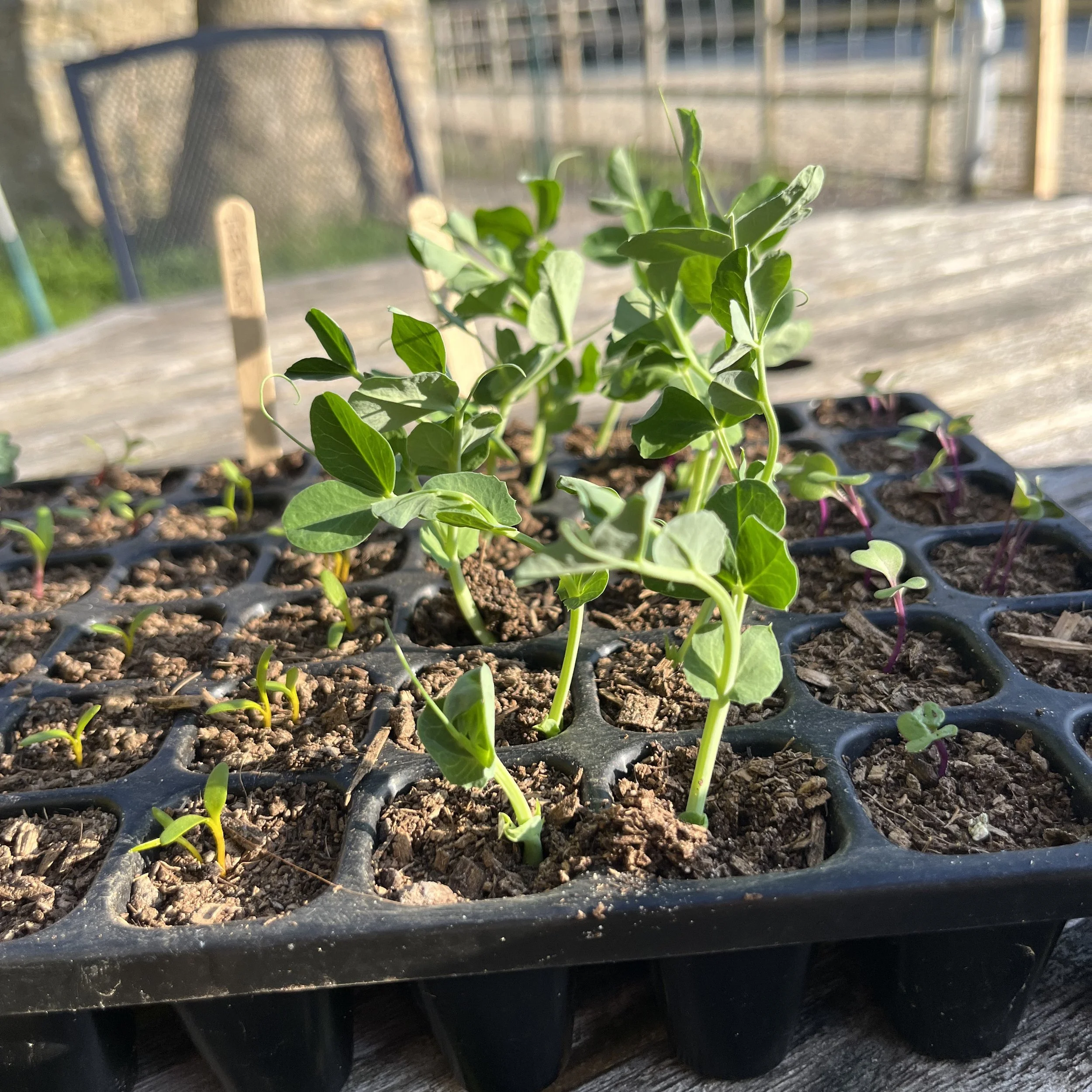
Heirloom seedlings: Mulatka beetroot, Sharpe’s Liberty pea, Ilka radish
They have always travelled like this. In pockets, in sacks, in the hands of those who kept them. Carried across landscapes, shared between neighbours, passed down through generations and over borders. We shape them, in small ways, by choosing what to keep and what to sow again. And in turn, they shape us - our diets, our seasons, the work we do.
It’s a strange thing, then, to talk about owning a seed. We buy them, of course. We choose varieties, order them, line them up neatly on a shelf. There’s nothing inherently wrong in that. But it carries with it a certain way of thinking. The garden as something selected, assembled, put together piece by piece - like flat-pack furniture, designed for predictability and ease. Choose, install, replace.
A garden can be made like this.But it can also be entered into. Worked with, over time. Allowed to shift and settle. In that kind of garden, seeds are not just inputs. They are participants in a longer process. Something is accumulated - not just yield, but familiarity, resilience, a kind of memory held in the plants themselves.
The seeds I sow this year may not be exactly the ones I sow next year. If I save them, they will carry something of this place with them. This soil. This weather. This particular year. They will be the same, and not the same. A quiet, ongoing adjustment. Not dramatic. Not visible all at once. But real.
And so the work continues. Trays filled. Seeds placed. Labels written, or forgotten. Nothing especially impressive about it. No finished garden, no immediate result. Just small things, done at the right time, in the right conditions. The equinox passes almost unnoticed. The days lengthen. The soil warms. What has been prepared begins to move.
The light has turned. What continues from here is what matters.