
February
In February, the garden looks quiet.
Beds are bare. Trees are leafless. The clay holds the memory of rain. On some mornings the frost lingers in the shaded corners until lunchtime or beyond. From a distance, it can seem as though nothing is happening.
But beneath the surface, work is already underway.
At this time of year you can often find me spreading compost, laying well-rotted manure, topping up woodchip paths, and making sure no ground is left exposed to the battering of winter rain. It can look unglamorous. Wheelbarrows of dark matter. Mud on boots. Slow, repetitive work.
But I love it. They say that wood warms you three times: once when you’re cutting it, once when you’re stacking it, and once when you’re burning it. The same is true of mulch. It warms you when you’re gathering the materials to make it. It warms you when you turn it, feeding the biological processes within. And it warms you again when you spread it on your beds.
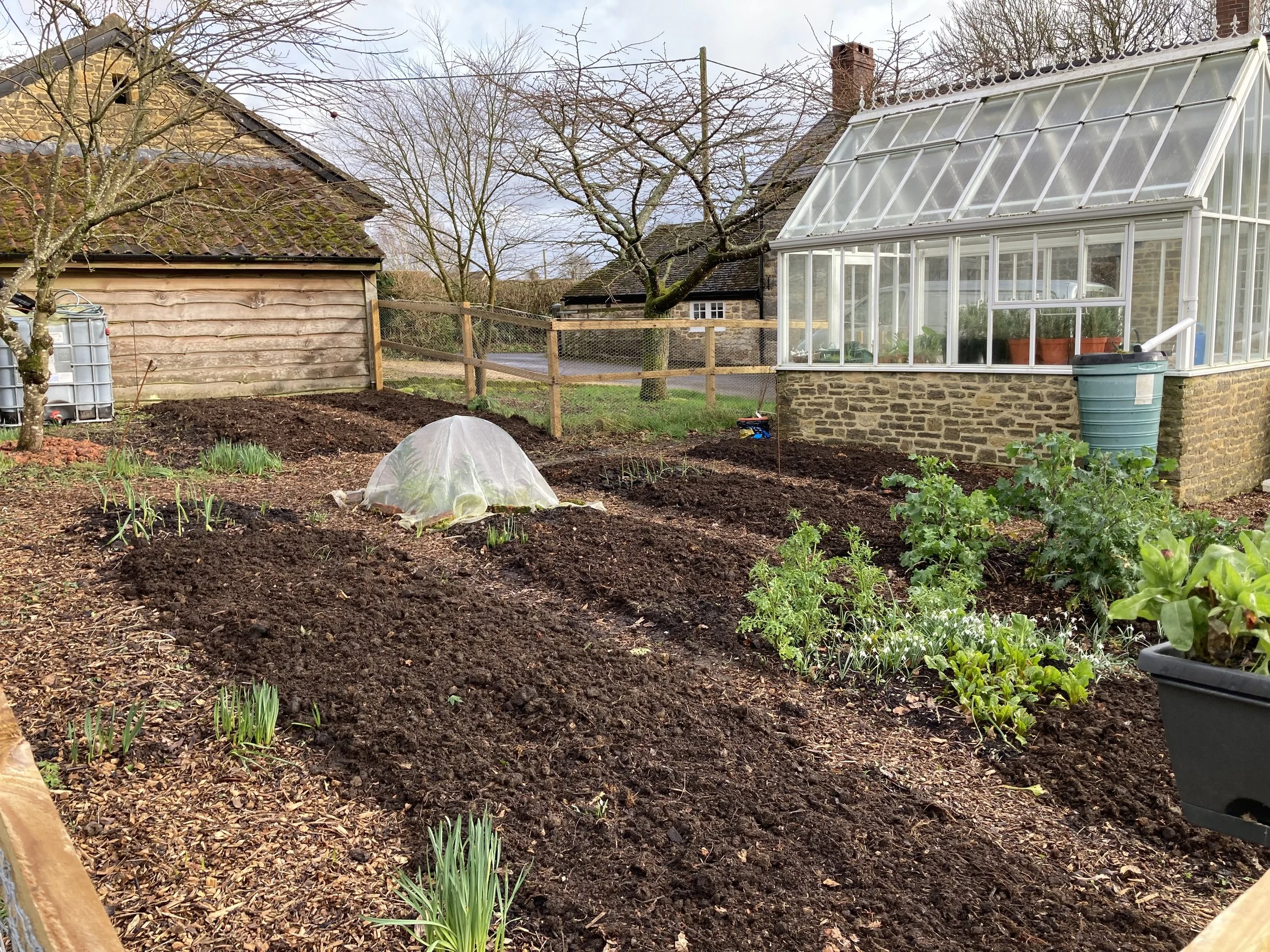
Foundations first - compost laid, soil fed, season beginning.
But there’s something deeper taking place here too. Because plants, contrary to popular belief, don’t eat compost. Fungi do. Bacteria do. Earthworms do. Countless unseen organisms break it down, transform it, and move it through the soil profile. They create structure. They store carbon. They hold moisture. They unlock nutrients gradually, and in balance. When we feed soil life, we build a system that feeds plants for us. This is gardening as relationship.
There is, however, another model of growing. One that feeds crops directly with synthetic nitrogen. Corrects deficiencies with soluble fertilisers. Chases visible growth. Responds quickly to problems with stronger and stronger interventions. It can certainly produce results - sometimes dramatic ones. But it often weakens the underlying system, and creates a dependency. Plants grow accustomed to regular chemical feeding, and without thriving soil life beneath them they struggle to sustain themselves.
A Living Garden works differently. It builds organic matter year by year. It protects structure. It encourages diversity underground as much as above it. Instead of asking, “what does this plant need right now?” it asks, “what does this soil, this ecosystem, this garden need long-term?”.
When soil health improves, plants become more resilient. They cope better with drought. They resist disease more effectively. They root deeper. The garden becomes steadier, less reactive. Abundance becomes the natural result of healthy soil, not something forced at any cost.
February matters because soil biology wakes before we see it. Even while beds look dormant, microbial life is stirring as temperatures edge upward. Earthworms are active beneath mulch layers. Fungal networks remain intact, waiting to reconnect with new roots in spring.
Adding compost now buffers temperature swings, protects soil from heavy rain, and gives soil organisms time to incorporate organic matter before rapid growth begins. It is quiet preparation, and preparation is stewardship. You act before the need is visible. You strengthen foundations rather than chase symptoms.
There is a discipline to this kind of work. Feeding soil offers no immediate aesthetic reward. It doesn’t photograph well. It doesn’t deliver instant flowers or harvests. It requires trust in processes you cannot see and patience for outcomes months - sometimes years - away. But every thriving kitchen garden, every resilient orchard, every wildflower meadow that holds its own through summer drought begins here. Underneath, in the unseen work.
This month I’ve been mulching beds that will carry vegetables later in the year. Topping up orchard trees with compost or woodchip around their drip lines. Protecting bare ground from compaction and erosion. Leaving roots in place wherever possible to maintain structure and feed soil organisms naturally.
It’s not dramatic work. But it is foundational. And when I’m doing this work I know that the mulch will warm me many more times yet. It will warm me in May, when I am sowing wildflowers and discover white threads of mycelium running through the earth. It will warm me in August, when the soil beneath holds its moisture through a dry spell. And it will warm me in November when I lift a leek and find earthworms turning dead leaves into dark, living soil. This is the kind of work I believe in - steady, seasonal and rooted in the long term.
In February, I feed the soil. The rest will follow.