
January
On a cold January morning, the orchard is quiet.
The trees are bare now, their structure laid open in a way it never is in summer. With no leaves to soften the lines, every branch tells a story — where light once fell, where weight pulled too hard, where a cut was made years ago and how the tree responded.
Pruning at this time of year doesn’t feel like gardening in the usual sense. It feels more like listening. Before any cut is made, there is a pause: looking at the shape of the tree, the balance of its limbs, the spaces where light might pass, the places where growth has crossed or crowded. The work is slow, deliberate, and quietly thoughtful.
It often strikes me, while pruning apple trees in winter, how easily care can be mistaken for control.
For much of human history, our relationship with the natural world has been shaped by the urge to dominate it: to straighten what is crooked, simplify what is complex, and extract as much as possible as quickly as possible. This mindset has left its marks everywhere — in exhausted soils, simplified landscapes, and systems pushed beyond their limits.
And yet the answer is not to withdraw our hands entirely.
Stewardship, done well, is something different. It is not about forcing nature into submission, but about working with living systems in a way that supports their long-term health, beauty, and usefulness. Thoughtful intervention can increase resilience rather than reduce it. It can create abundance without depletion, structure without rigidity.
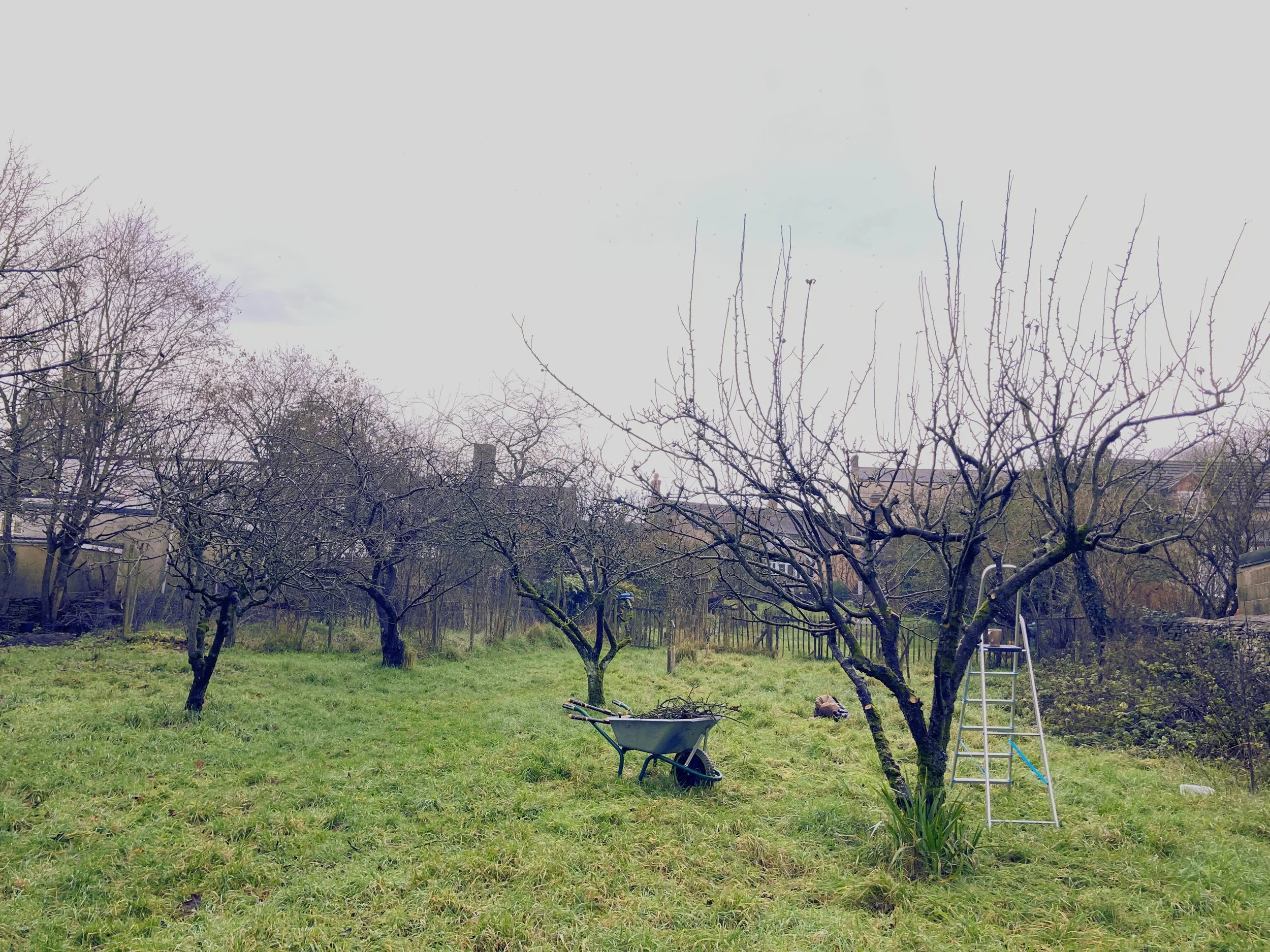
Winter pruning in the orchard — shaping structure while leaving space for growth.
An apple tree does not need us in order to grow. Left alone, it will reach for the light, send out shoots, tangle its branches, and bear fruit where it can. In ecological terms, there is nothing “wrong” with this. Disease, breakage, and even death are all part of natural cycles, feeding soil life and making way for what comes next.
But an orchard is not just a collection of trees. It is a relationship between soil, plants, wildlife, and people. We care about light and airflow because they reduce disease pressure. We care about structure because it allows fruit to ripen evenly and be harvested without ladders scraping bark or branches tearing under their own weight. We care because we intend to return, year after year, and because the orchard is meant to be lived with.
Pruning, then, becomes a way of gently guiding growth rather than dictating it. By removing a branch here, shortening another there, we encourage the tree to put its energy where it can do the most good. We open space without stripping character. We clarify form without imposing symmetry.
But the line between guidance and force is a fine one.
Heavy-handed pruning can shock a tree, provoking a rush of weak, upright growth or distorting its natural shape. Cuts made without understanding can undo years of patient development in a single afternoon. Too much intervention, just like too little, leads to imbalance.
Good stewardship sits somewhere in the middle. It requires restraint as much as action. It asks for attention, experience, and a willingness to accept that not everything can — or should — be perfected.
One of the humbling things about working with trees is the timescale involved. The results of a winter’s pruning won’t fully reveal themselves for years. A thoughtful cut now may improve structure a decade from today. A poor one will be carried just as long. Stewardship teaches patience, and a certain humility: you are shaping something you will never fully finish.
January is a fitting time for this work. There is little growth to distract the eye, and no urgency to produce. It is a season for correction rather than creation — for setting the conditions that will allow life to unfold well when the time comes.
In the orchard, stewardship looks like a person with secateurs standing quietly beneath a bare tree, choosing what to remove and what to leave. It is an act of care that accepts limits, works with what is already there, and trusts that, given the right conditions, nature will do most of the rest on its own.