
August
By the time August arrives, the garden has become a very different place. Flowerbeds that seemed fresh and abundant in June now lean and spill across the paths. Lawns that were green only weeks ago have faded to shades of gold and brown. In the orchard, one apple tree hangs heavy with fruit while another has produced only a modest crop, its leaves curling after a long dry spell.
It is easy to look at these changes and think that something has gone terribly wrong. We compare the garden before us with the one we remember from early summer and wonder how to restore it to its former glory. But perhaps the mistake lies not in the changes we see, but in imagining that the garden ever stood still in the first place.
We are surrounded by images of gardens at their most spectacular. Magazine covers celebrate the perfect spring border and social media rewards the most beautiful moment. Yet photographs freeze a single instant in something that is always changing. Photographs capture a moment, but cannot convey the movement and life around it. A garden is not a picture; it is a process, alive and continually becoming.
When we design a garden, we think carefully about three dimensions: the height a tree will eventually reach, the width of a border, the curve of a path. Yet we often forget the fourth dimension: time. Gardens are not static compositions but unfolding stories. Every day is different. Every season changes them; every year reshapes them.
The same is true of all living systems. Woodlands alter, rivers slowly shift their course, and meadows change as flowers and grasses compete, establish themselves and fade away. Change is not evidence of failure. It is evidence of life. The question is not how we stop it, but how we respond.
There are limits to what we can control. We cannot make it rain, prevent every heatwave or avoid every outbreak of disease. For some, this can sound discouraging. Yet these limits are not reasons for despair. They are conditions, and conditions can be adapted to. A sailor cannot control the wind, but can learn to read it, trim the sails and alter course.
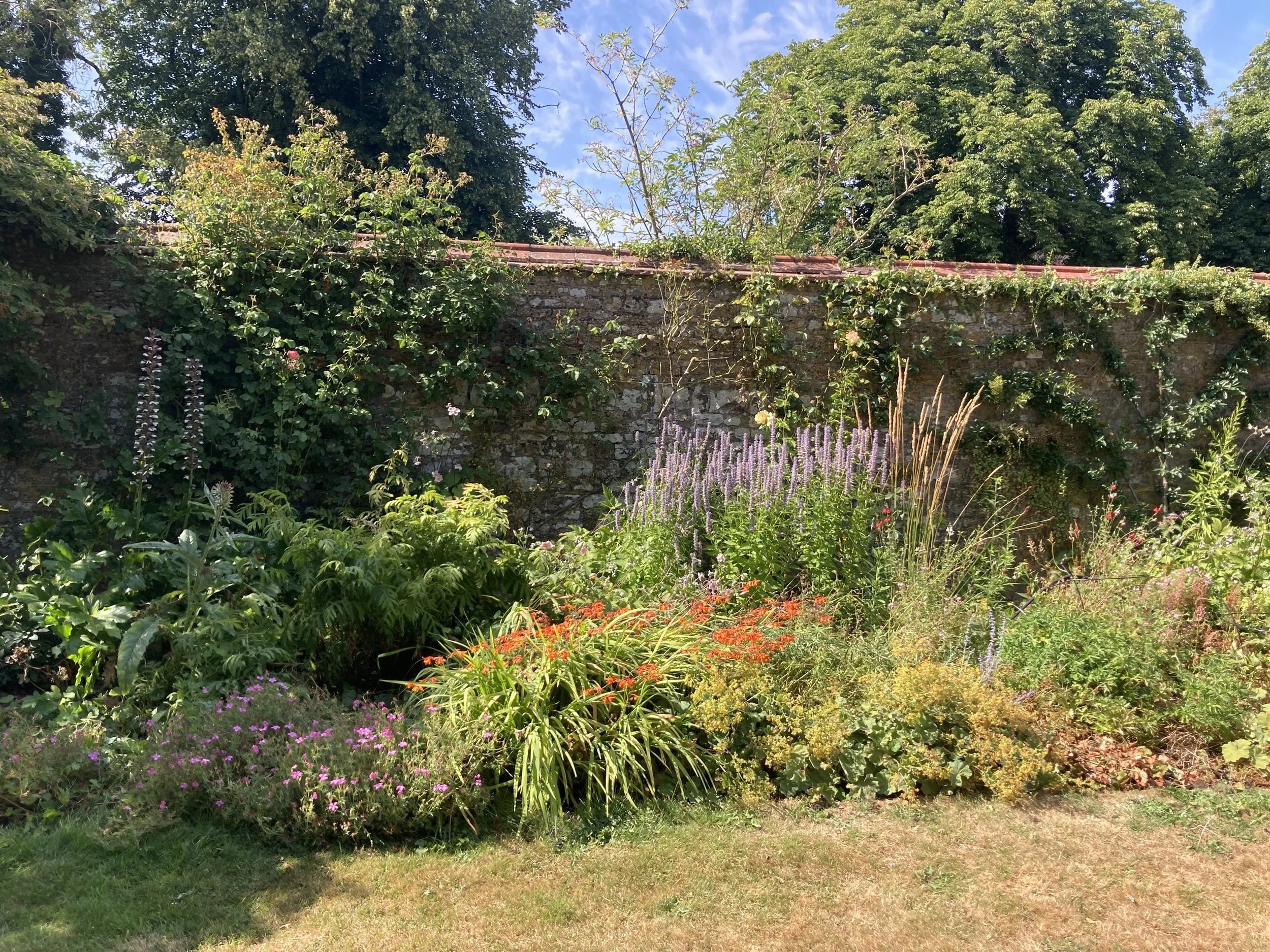
A dry August lawn beside a border still full of life: changing conditions do not end the gardener’s agency, but redirect it
Likewise, gardeners cannot choose the weather, but we can improve the soil so that it holds water for longer. We can plant trees that cast cooling shade, increase diversity so that no single pest or disease overwhelms the garden, harvest rainwater, encourage wildlife and notice which plants flourish naturally in a changing climate. Our agency is not lost; it is redirected.
Instead of asking, ‘How can I preserve my garden exactly as it was?’ we might ask, ‘How can I help this place flourish under the conditions it now faces?’ That is an active question. It demands observation rather than assumption, curiosity rather than certainty. It asks us to experiment, adapt and learn from the garden rather than impose a fixed idea of what it should be. It keeps the gardener responsive.
A living garden is far more than a collection of beautiful plants. It is a web of relationships between flowers and pollinators, trees and fungi, birds, insects, worms, microbes, rainfall and sunlight. Each influences the others, creating something richer than any individual organism could achieve alone. The gardener belongs within that web too.
We often imagine ourselves outside the garden, maintaining it as an engineer maintains a machine. Yet we are another species living within these places, no less part of the system than the blackbird searching for worms, bees moving between flowers or fungi weaving through the soil. From this understanding, stewardship emerges.
A steward does not preserve a place in aspic, freezing it at one perfect moment. They help it continue its story, recognising that every landscape belongs to a longer narrative shaped by seasons, weather, wildlife and those who cared for it before. Their task is not to stop change, but to guide it wisely.
The goal of gardening is not to hold a landscape still. It is to recognise that we belong within it, to take our place in the living system and become wise participants in an evolving story. To help the garden keep becoming.