
October brings one of my favourite days of the gardening year. A small group of friends and family gathers in an orchard to pick, press and preserve apples. What began as an informal get-together has become a tradition. Standing at the old press, watching the juice begin to run, I find myself wondering what a garden is for.
Food is an obvious answer, particularly here. But the orchard gives us other things too: somewhere to gather, a reason to spend the day outside and a ritual that brings us back together each autumn. Earlier in the year, the same trees gave us blossom. In summer, they offered shade.
Different people need different things from a garden. Somewhere to grow vegetables, somewhere for children to play, somewhere quiet to sit after work. Beauty matters too. A tree in blossom can make you stop what you are doing and look. That is a worthwhile contribution, even if it cannot be weighed or bottled.
The apples passing through the press are the result of work that began long before today. There were insects moving through the blossom, roots growing through the soil and someone deciding which branches to prune last winter. Much of what makes a harvest possible is easy to overlook when the fruit is finally in front of us.
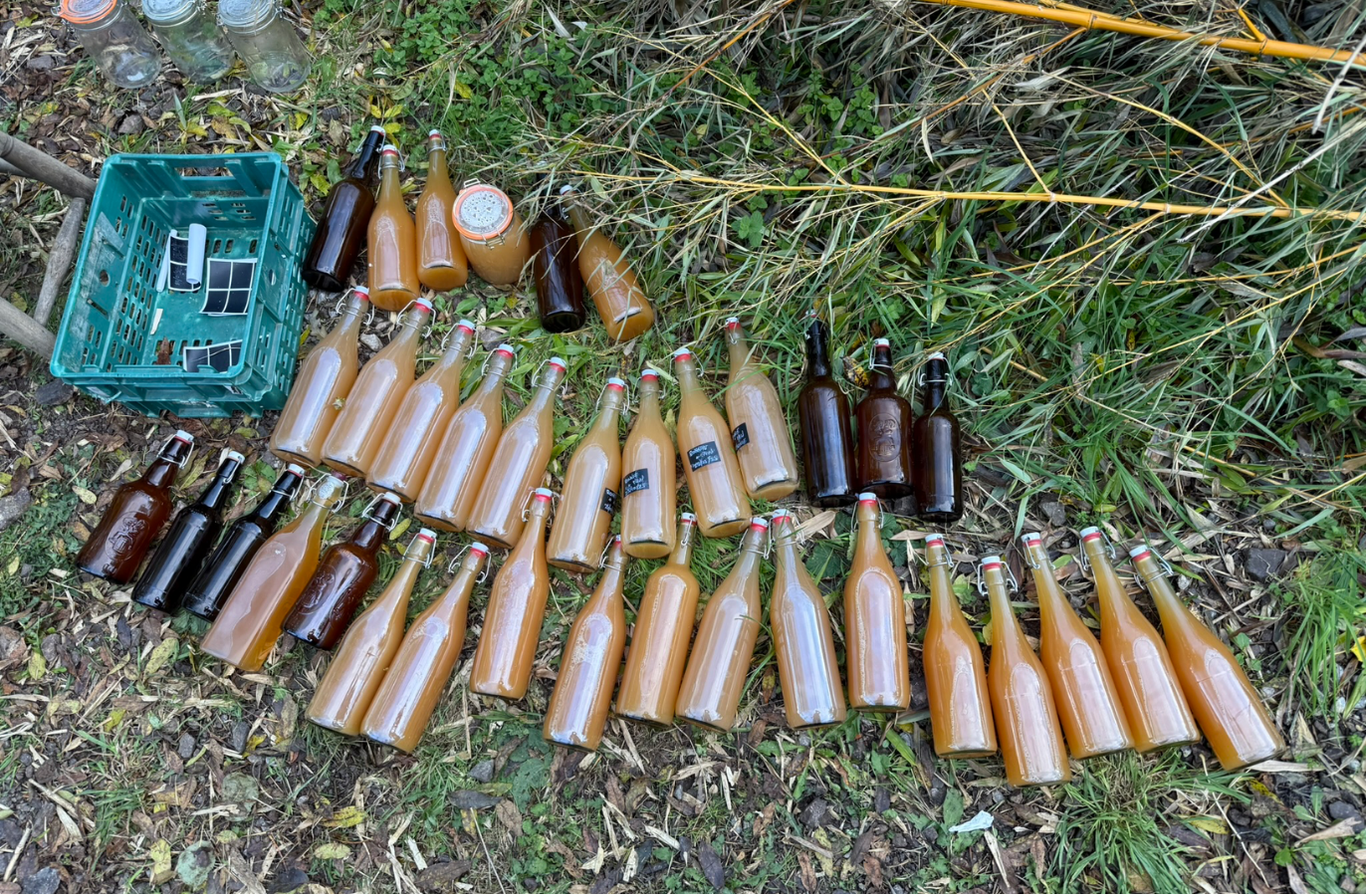
The result of a day’s pressing, and a year’s growth: apple juice ready to take home and share.
In my own work, I try to pay attention to these relationships. Planting early-flowering bulbs beneath fruit trees provides food for insects before the apple blossom opens. Carefully pruning a crowded canopy brings light and air back into the tree. Looking after an orchard means considering what happens beneath and around the branches, as well as what grows on them.
No two harvests are quite the same. Weather plays its part, but neighbouring trees can respond very differently to the same season. Their variety, condition and previous crop all matter. A disappointing year is a reason to look more closely before deciding that something needs changing.
At the press, appearance becomes less important. Small or misshapen apples can make excellent juice. Once they have passed through, nobody can tell which fruit would have looked best on a supermarket shelf.
I often think something similar happens in gardens. An old fruit tree, an overgrown boundary or a shaded corner may have more to offer than first appears. An ageing tree might benefit from gradual pruning. A rough boundary might become a good hedge. A damp corner might support planting that would struggle elsewhere.
Understanding what is already there helps us decide what to do next. Sometimes a place needs substantial change. Sometimes it needs a little care and enough time for that care to show.
By lunchtime, apples from many different trees have mingled in the juice. We have something to take home, but we have also spent a morning working together in a place that has become part of our lives.
When I think about what a garden is for, that belongs in the answer too.