
For me, the gardening year begins with an ending. In September, I cut the meadow I sowed last year. A few hours of scything brings its shoulder-high growth down to short tufts, with the summer’s flowers lying in rows across the ground. It can look rather severe. But light is reaching the soil again, and the conditions for next year’s growth are beginning to take shape.
A meadow depends on this kind of intervention. Cutting and removing the growth helps keep fertility down and prevents vigorous grasses from overwhelming the finer meadow plants. The timing needs some thought. I want the flowers to have set seed, and I may leave a late-flowering patch standing a little longer.
This is part of why I like working with a scythe. It is quiet work, and it brings me close enough to notice what is happening. I can work around a plant, change the height of the cut or leave an area untouched. As the meadow comes down, I see what has established well and where the balance is changing.
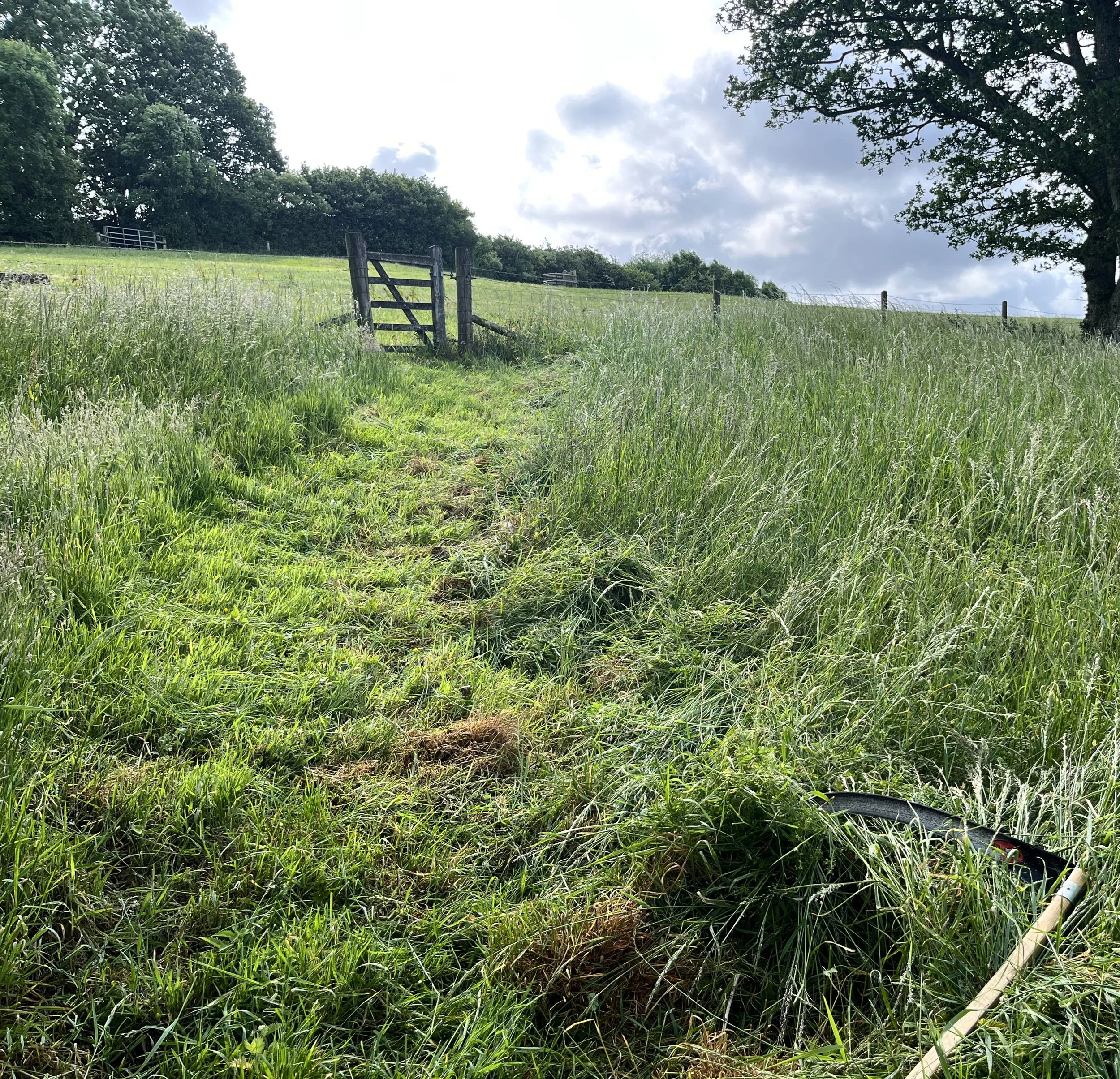
Cutting the meadow brings light back to the ground and begins the work of next year’s growth.
This year, the ground beneath it was cracked and dusty. Elsewhere, grass had stopped growing early, trees were shedding leaves and recently planted shrubs were struggling. The drought had made differences within the garden much more visible.
It is tempting to respond by watering more or replacing whatever has suffered. Sometimes that is necessary, but first I want to understand why a plant struggled. Was it still establishing? Was the soil compacted? Was it competing with a mature tree, or growing somewhere that never really suited it? One difficult summer can reveal a problem that has been developing for years.
Autumn gives us an opportunity to act on these observations. In the perennial border, clumps that looked generous in early summer may now have bare centres or be crowding their neighbours. Dividing them can restore their vigour and provide plants to repeat elsewhere. It also gives me a chance to reconsider the border as a whole: what flowered when, where the gaps were and which plants need more room.
Moving a plant is sometimes an admission that an earlier decision did not work. I think that is a useful part of gardening. Conditions change, plants grow larger than expected and we learn things about a place that we could not have known at the start. There is little value in keeping something in the wrong position simply because we put it there.
Much of this work offers very little immediate reward. A divided clump or a newly moved shrub may look less impressive than it did before. Its value becomes clear later, when growth returns and the planting begins to settle into its new arrangement.
Back in the meadow, the height and colour have gone. There is more space, more light and a clearer view of the ground. I am already thinking about what I will see here next summer.
Autumn can feel like a season of finishing jobs. But some of the most worthwhile work we do now will only become visible next year.